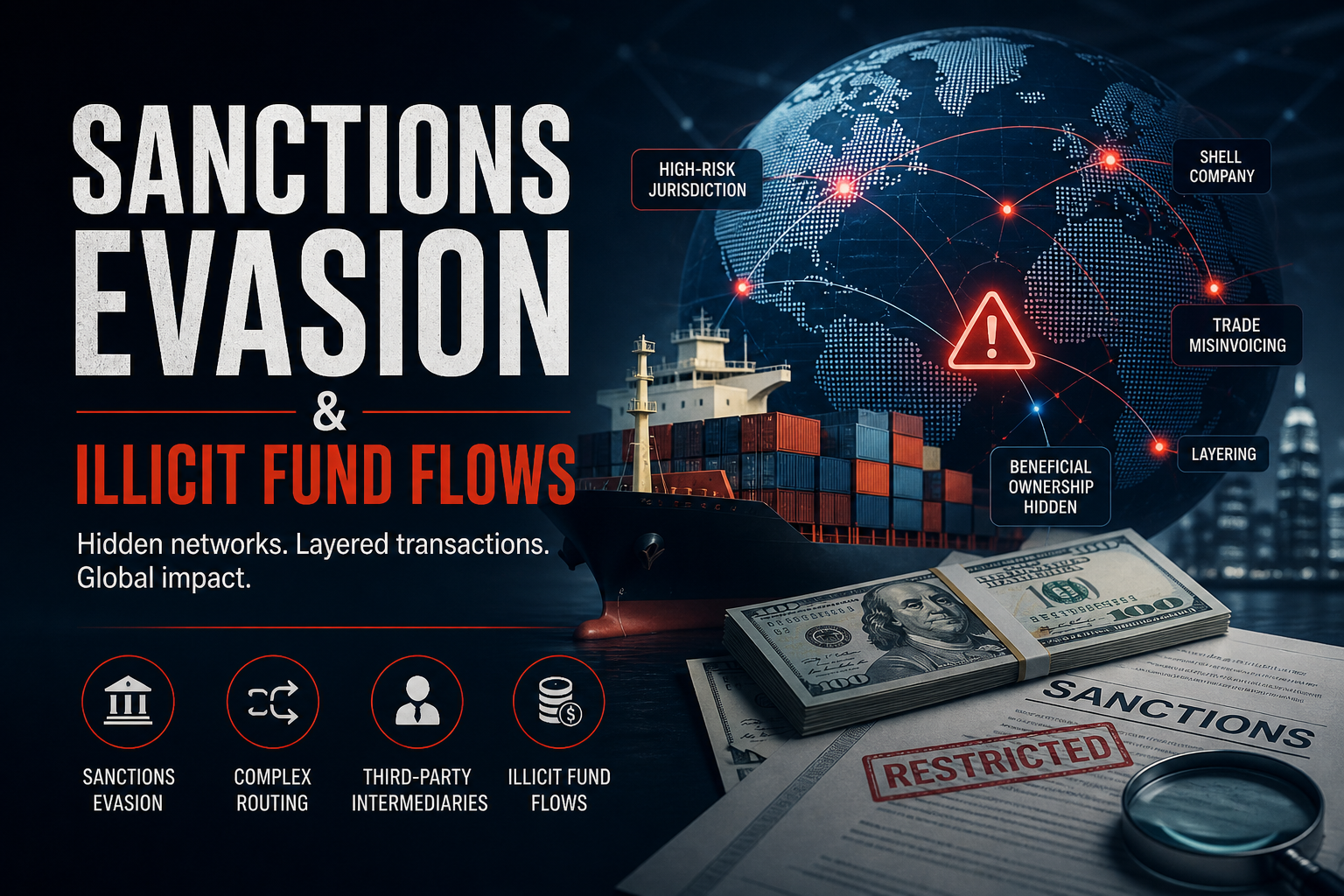
Sanctions Evasion & Illicit Fund Flows: What Financial Institutions Need to Watch
Sanctions evasion is no longer confined to a handful of high-risk jurisdictions or obvious counterparties. It has evolved into a complex, adaptive practice where illicit fund flows are carefully embedded within legitimate trade, payment, and financial activity.
For financial institutions, the challenge is not just identifying sanctioned entities. It is understanding how financial crime is being structured to avoid detection altogether.

What Is Sanctions Evasion?
Sanctions evasion refers to the deliberate attempt by individuals, entities, or networks to bypass economic or financial restrictions imposed by governments or international bodies.
These restrictions may target:
- Specific countries or regions
- Designated individuals or organisations
- Sectors such as energy, defence, or dual-use goods
Evasion occurs when actors restructure transactions, relationships, or financial flows to obscure their connection to sanctioned parties or restricted activities.
What Are Illicit Fund Flows in This Context?
Illicit fund flows are the movement of money that is illegal in origin, purpose, or destination — or structured to appear legitimate while concealing underlying sanctions exposure.
In sanctions evasion cases, these flows are often:
- Routed through multiple jurisdictions
- Split across accounts, entities, or payment types
- Embedded within otherwise legitimate commercial or financial activity
The objective is simple: make the movement of restricted value look like normal business.
How Sanctions Evasion Has Evolved
Traditional sanctions evasion relied on direct methods — undisclosed ownership, falsified documentation, or simple routing through less scrutinised jurisdictions.
Today, the approach is far more layered.
Evasion techniques now focus on:
- Embedding activity within legitimate systems (trade, payments, platforms)
- Fragmenting transactions to avoid visibility
- Using intermediaries with plausible commercial roles
- Creating narratives that justify the flow of funds
What makes this evolution significant is that individual transactions often appear commercially valid. The risk only becomes visible when viewed across relationships, timing, and behaviour.
Common Sanctions Evasion Typologies
While methods continue to evolve, several patterns are consistently observed across financial systems:
1. Trade-Based Concealment Through Intermediaries
Restricted goods or services are procured through third-country distributors or trading firms to obscure the true buyer and end use. Payments are fragmented across invoices, logistics costs, and service fees.
2. Corporate Service Payment Layering
Funds are routed as advisory fees, consulting charges, retainers, or administrative payments across multiple entities. The receiving parties may appear legitimate, but their commercial role is often unclear.
3. Merchant Settlement and Platform-Based Laundering
Illicit funds are embedded within merchant collections, refunds, and settlement flows processed through payment aggregators or digital platforms. Reversals and payout recycling add further complexity.
4. Humanitarian and NGO Channel Misuse
Transactions are structured as grants, field support payments, or programme expenses routed through NGOs or partner entities. The operational context appears legitimate, but visibility into end use is limited.
Key Risk Indicators Financial Institutions Should Track
Sanctions evasion rarely reveals itself through a single transaction. It emerges through patterns.
Some indicators to watch:
- Payments routed through third-country intermediaries without clear commercial rationale
- Fragmented settlement patterns across multiple accounts, currencies, or transaction types
- Repeated transactions involving entities with limited operational substance
- Payment flows that do not align with the customer’s business profile or expected behaviour
- Unusual use of refunds, reversals, or non-standard payment structures
- Complex chains involving multiple layers of counterparties with unclear relationships
The absence of transparency is often the strongest signal.
Why Detection Is Increasingly Difficult
The biggest challenge is that sanctions evasion is designed to blend in.
Each participant in the financial ecosystem sees only part of the activity:
- Banks see account behaviour
- Payment providers see transaction flows
- Trade participants see invoices and shipments
Individually, these signals may appear normal.
The risk lies in what connects them.
Without cross-entity visibility and contextual analysis, the broader pattern remains hidden.
What Needs to Change
Static rules and isolated monitoring are no longer sufficient.
Effective detection now depends on:
- Behavioural monitoring, not just transaction thresholds
- Network-level analysis across entities, accounts, and flows
- Real-time detection capabilities to identify evolving patterns
- Scenario-driven intelligence based on real-world typologies
- Stronger collaboration across institutions and jurisdictions
Sanctions evasion is not a single event. It is a coordinated process.
Detection needs to reflect that.
Final Thought
Sanctions evasion today is less about breaking the rules directly and more about rewriting the appearance of compliance.
Funds move.
Transactions clear.
Everything looks normal.
Until it doesn’t.
For financial institutions, the focus must shift from identifying isolated anomalies to understanding the broader financial story being constructed.
Because in sanctions evasion, what matters is not just where the money goes — but how convincingly it gets there.
Experience the most intelligent AML and fraud prevention platform
Experience the most intelligent AML and fraud prevention platform
Experience the most intelligent AML and fraud prevention platform
Top AML Scenarios in ASEAN
The Role of AML Software in Compliance