Real-Time Payments (RTP) Laundering Risks
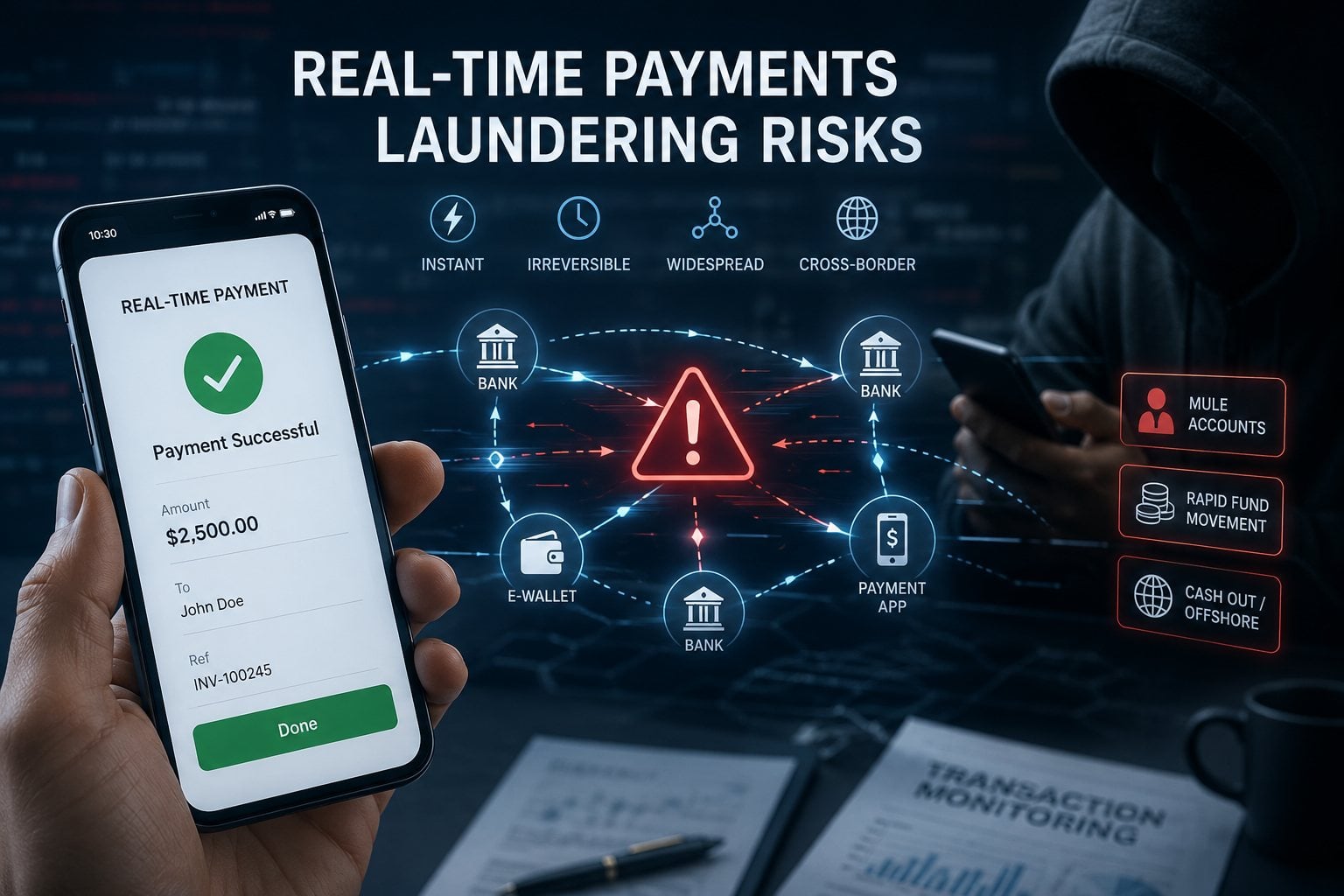
Real-Time Payments (RTP) laundering risks refer to the misuse of instant payment systems to move, layer, or cash out illicit funds at high speed. These risks arise when criminals exploit payment rails that allow funds to be transferred almost instantly, often with limited time for financial institutions to detect, investigate, or stop suspicious activity before the money moves onward.
Real-time payment systems are designed for speed, convenience, and certainty. But those same features can be misused by fraudsters, mule networks, scam syndicates, and money laundering groups to move proceeds across accounts, wallets, payment service providers, and banks within minutes or seconds.

How Real-Time Payments Can Be Misused
Criminals may use real-time payment channels to receive scam proceeds, fragment funds across multiple mule accounts, rotate beneficiaries, or quickly move money into cash, crypto, remittance channels, or offshore accounts.
Common misuse patterns include:
- Scam victims authorising payments to fraudster-controlled accounts
- QR codes redirecting funds to unintended beneficiaries
- Mule accounts receiving multiple small-value instant transfers
- Rapid pass-through activity with little or no retained balance
- Funds split across several accounts shortly after receipt
- Dormant or newly opened accounts suddenly receiving frequent credits
- PayNow, UPI, PayID, Osko, FAST, wallet, or instant-transfer channels being used to layer funds
Because many RTP transactions are authorised by the customer, they may pass authentication checks even when the underlying purpose is fraudulent. This makes behavioural and beneficiary-level monitoring critical.
Why RTP Laundering Is Difficult to Detect
Traditional transaction monitoring systems may struggle to detect RTP laundering because individual payments can appear normal in isolation. A small transfer, a QR payment, or a peer-to-peer transaction may not trigger concern on its own.
The risk becomes clearer when institutions connect multiple signals, such as sender diversity, transaction velocity, beneficiary behaviour, payment references, device links, account age, and rapid onward movement.
In real-time payment environments, the detection window is narrow. By the time a victim reports the scam or an alert is reviewed, the funds may already have been dispersed across mule accounts or converted into other value stores.
Red Flags of RTP Laundering
Financial institutions should monitor for patterns such as:
- Multiple inbound payments from unrelated senders into the same account
- Sudden activity in dormant or low-activity accounts
- Repeated QR-linked or instant-payment credits
- Payment references mentioning prizes, donations, fees, gambling, investments, or urgent support
- Rapid outbound transfers shortly after funds are received
- Funds split across multiple accounts within a short period
- Frequent beneficiary additions or changes
- Low retained balances after high transaction volume
- Multiple accounts sharing devices, IP addresses, phone numbers, or identity attributes
- Customer complaints or fraud reports linked to the same recipient account
The strongest signal is often not one suspicious transaction, but a repeated pattern of fast-moving funds across connected accounts.
Examples of RTP Laundering Typologies
RTP laundering can appear across several scam and financial crime typologies, including:
- QR code donation diversion: Fraudsters replace legitimate donation QR codes with codes linked to their own accounts.
- PayNow-linked account misuse: Criminal actors use shared or surrendered access to genuine customer accounts to move illicit funds.
- Fake gambling or “scambling” networks: Scam proceeds are moved through fake online gambling platforms and mule accounts using instant payments.
- UPI jumped deposit scams: Victims unknowingly authorise larger outbound payments after receiving small inbound credits.
- Authorised push payment scams: Victims are manipulated into initiating transfers to fraudster-controlled accounts.
Why It Matters for Financial Institutions
RTP laundering sits at the intersection of fraud, payments, and AML. A transaction may begin as a scam loss, but once the funds move through mule accounts, payment wallets, bank accounts, or remittance channels, it becomes a wider financial crime and money laundering concern.
Banks, fintechs, payment service providers, and wallet operators need monitoring systems that can identify not just the first payment, but the wider money trail that follows.
Effective detection requires a connected view of customer behaviour, beneficiary risk, account relationships, payment velocity, and network-level movement.
How FinCense Helps
Tookitaki’s FinCense helps financial institutions detect RTP laundering patterns by combining transaction monitoring, behavioural analytics, mule account detection, screening, and case management in one platform.
FinCense can help identify unusual payment velocity, multiple victim payments into common beneficiaries, rapid onward transfers, dormant account reactivation, suspicious QR or instant-payment behaviour, shared device or identity indicators, and connected account networks.
Through the Anti-Financial Crime (AFC) Ecosystem, FinCense also helps institutions stay updated on emerging typologies, allowing them to respond faster as criminals adapt to new real-time payment channels.
Key Takeaway
Real-time payments have transformed financial access and convenience. But their speed can also be exploited by criminals to move illicit funds before traditional controls can respond.
For financial institutions, the priority is clear: detect the money trail in real time, connect fraud and AML signals, and identify laundering behaviour before funds disappear across the network.
Experience the most intelligent AML and fraud prevention platform
Experience the most intelligent AML and fraud prevention platform
Experience the most intelligent AML and fraud prevention platform
Top AML Scenarios in ASEAN
The Role of AML Software in Compliance