Misuse of Insurance and Investment Products for Financial Crime
Misuse of insurance and investment products for financial crime refers to the exploitation of insurance policies, claims, commissions, trusts, investment accounts, and securities markets to commit fraud, conceal ownership, move illicit funds, or generate unlawful financial gains.
Because these activities often involve legitimate financial products, suspicious transactions can initially appear to be normal insurance reimbursements, commissions, investment returns, or securities trades.
How Insurance and Investment Products Are Misused
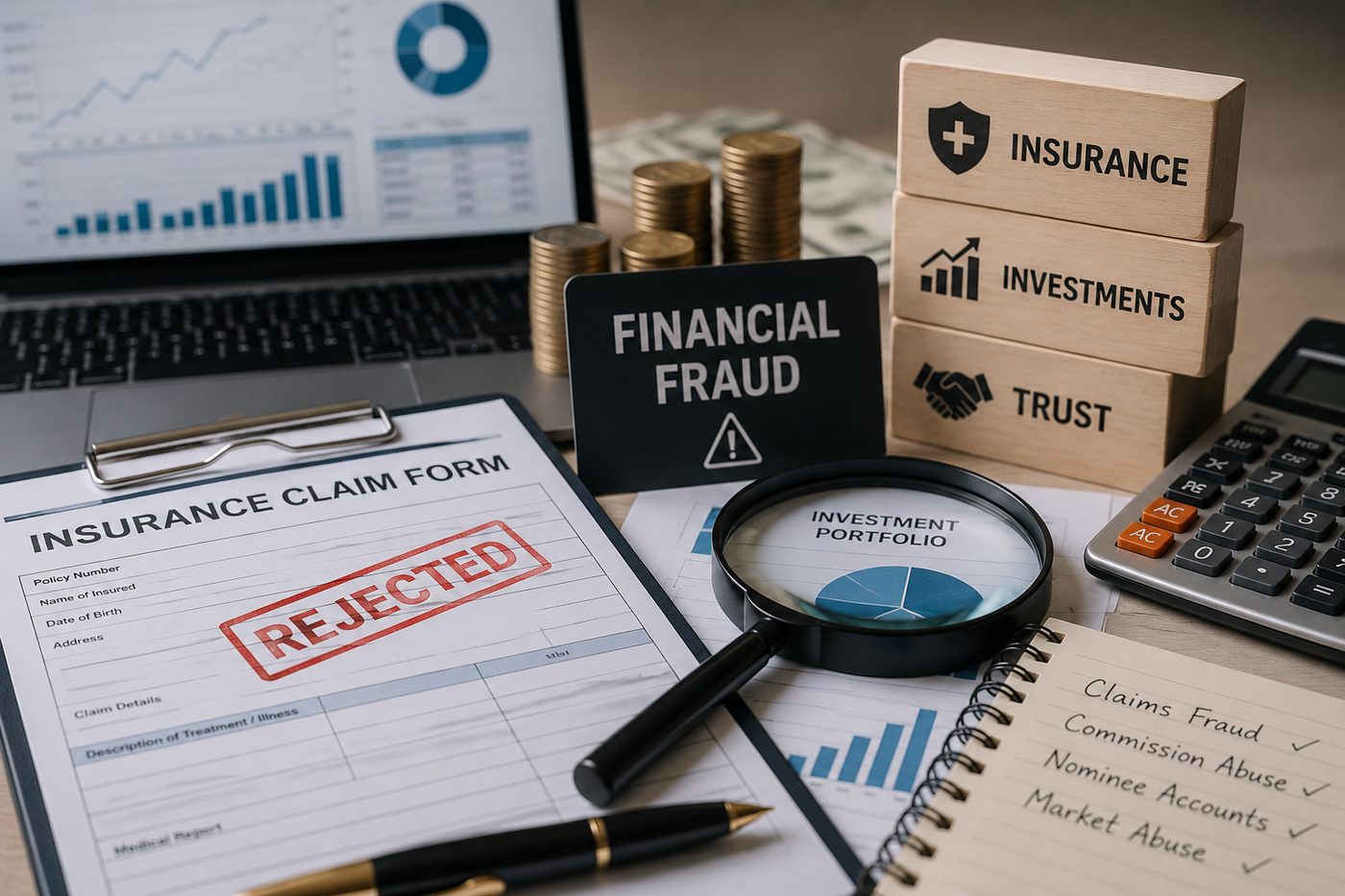
Common forms of misuse include:
- Fraudulent insurance claims: Forged or falsified documents are used to claim reimbursement for treatments or expenses that are not genuinely covered.
- Insurance commission fraud: Agents exploit front-loaded commission structures using dummy agents and policies designed to lapse after commissions are paid.
- Nominee-held investment accounts: Trusts or hidden controllers use nominees to hold capital markets accounts while retaining beneficial ownership and control.
- Investment-based laundering: Criminal proceeds are invested so that returns can appear to be legitimate investment income or capital gains.
- Market abuse: Confidential institutional trading information is shared with connected parties who trade ahead of pending orders for an unfair advantage.
Key Red Flags
Financial institutions should look for indicators such as:
- Repeated insurance reimbursements to multiple unrelated accounts
- Insurance payouts rapidly transferred or withdrawn after receipt
- Multiple agents transferring similar-value commissions to a common recipient
- Policies generating high first-year commissions before quickly lapsing
- Apparently unrelated customers sharing devices, IP addresses, contact details, or beneficiaries
- Capital markets accounts funded or directed by trusts or third parties rather than the named holder
- Offshore funding inconsistent with the account holder’s profile or source of funds
- Nominee arrangements where the true beneficial owner does not appear on the account
- Connected accounts repeatedly trading shortly before institutional or mutual fund orders
Why Detection Can Be Difficult
The underlying financial products and transactions may be legitimate even when they are being misused.
An insurer-issued reimbursement, officially recorded commission, investment return, or securities trade may not appear suspicious in isolation. Risk becomes clearer when institutions connect patterns across policyholders, agents, providers, trusts, nominees, accounts, counterparties, and trading activity.
This makes behavioural analysis, beneficial ownership transparency, transaction monitoring, and network-level correlation important for effective detection.
Why It Matters for Financial Institutions
Insurance and investment products can give illicit activity an appearance of legitimacy because funds may originate from regulated insurers, investment accounts, or securities transactions.
Banks, insurers, investment firms, asset managers, brokerages, and fintechs therefore need to assess not only individual transactions but also customer behaviour, source of funds, ownership structures, connected parties, policy activity, and transaction patterns.
How FinCense Helps
Tookitaki’s FinCense helps financial institutions identify suspicious patterns across customers, accounts, counterparties, transactions, and behavioural indicators.
Combined with financial crime intelligence from the AFC Ecosystem, institutions can strengthen detection of risks linked to insurance fraud, commission abuse, nominee-held investments, beneficial ownership concealment, investment-based laundering, and market abuse.
Key Takeaway
Insurance and investment products can be exploited for financial crime precisely because they are legitimate financial instruments.
Effective detection requires institutions to look beyond individual claims, payouts, investments, or trades and identify the relationships, behaviours, and patterns that reveal coordinated misuse.
Experience the most intelligent AML and fraud prevention platform
Experience the most intelligent AML and fraud prevention platform
Experience the most intelligent AML and fraud prevention platform
Top AML Scenarios in ASEAN
The Role of AML Software in Compliance