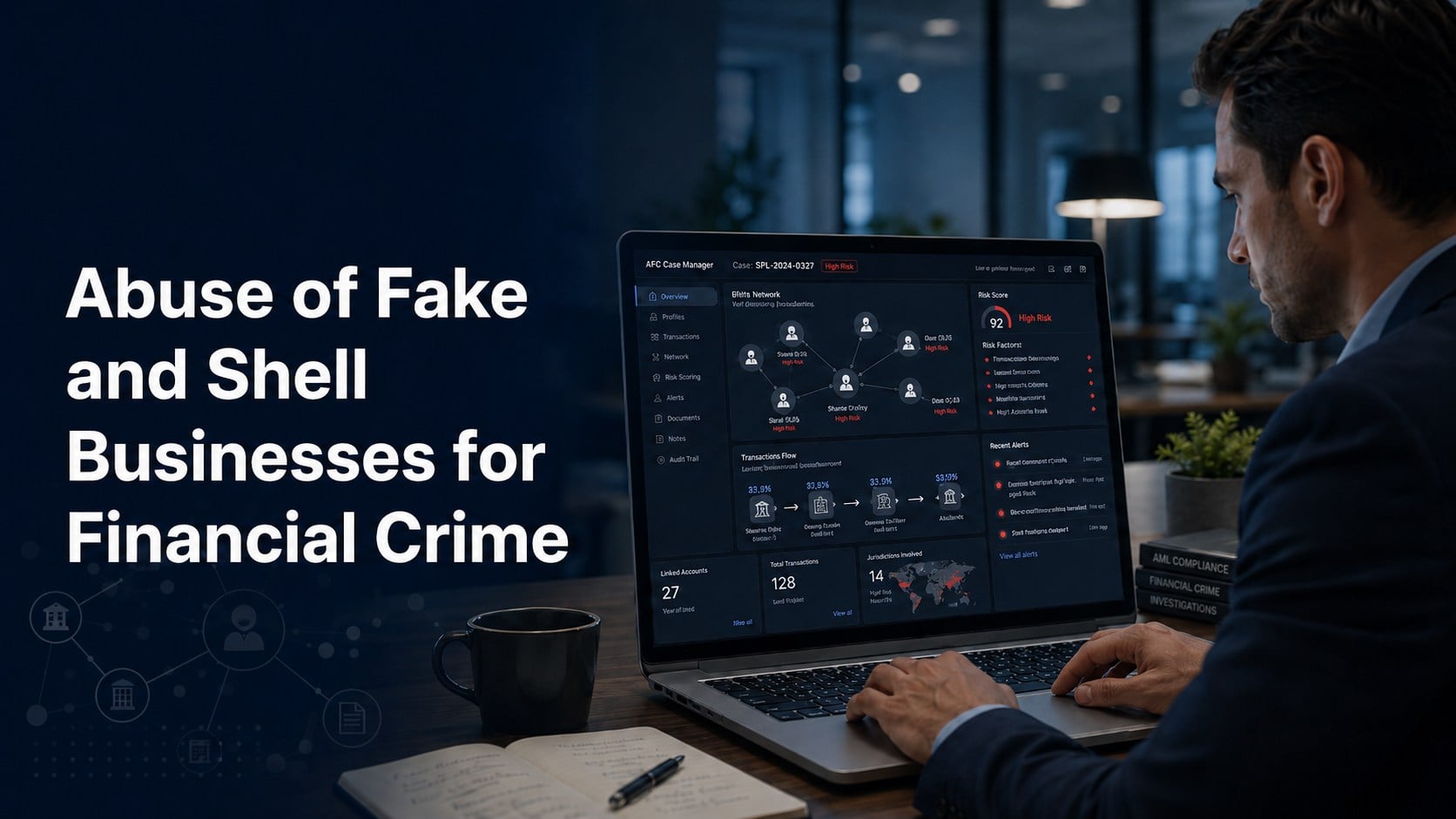
Abuse of Fake and Shell Businesses for Financial Crime
Abuse of fake and shell businesses for financial crime refers to the use of companies, merchant accounts, retail fronts, trading firms, or other apparently legitimate enterprises to conceal fraud, collect illicit funds, harvest identities, and launder criminal proceeds.
These businesses may exist only on paper, operate with little genuine commercial activity, or combine legitimate-looking operations with criminal conduct. Their formal appearance helps criminals gain the trust of victims, access financial services, open business accounts, and distance the true beneficiaries from suspicious transactions.

How Fake and Shell Businesses Are Misused
Criminal networks may establish or control companies that appear to provide trading, investment, consultancy, retail, payment, or membership services. These fronts are then used to receive victim payments, open accounts under false identities, or move funds through apparently legitimate business channels.
Common misuse patterns include:
- Shell companies receiving deposits from numerous unrelated individuals
- Sham investment or trading firms collecting funds through fake platforms
- Merchant accounts and QR codes being used to receive advance-fee scam payments
- Retail or membership schemes harvesting customer identity documents
- Corporate and personal accounts opened under fictitious or stolen identities
- Newly incorporated businesses showing activity inconsistent with their stated purpose
- Funds rapidly transferred through mule accounts, remitters, cash withdrawals, or digital currency exchanges
- Multiple businesses or accounts sharing devices, IP addresses, contact details, directors, or beneficiaries
Because the receiving account may belong to a registered company or apparently legitimate merchant, the activity can initially resemble ordinary commercial payments.
Why This Activity Is Difficult to Detect
Traditional controls may assess a company primarily through registration documents, declared business activity, ownership information, and expected account usage. Criminals exploit this by creating businesses that appear legitimate at onboarding but operate differently once accounts become active.
Individual transactions may also appear plausible in isolation. An investment deposit, membership payment, consultancy fee, or merchant transfer may not seem suspicious without wider context.
The risk becomes clearer when institutions connect signals such as unrelated third-party deposits, recently incorporated entities, nominee directors, shared digital identifiers, inconsistent customer profiles, rapid fund dispersal, and linked account clusters.
Red Flags of Fake and Shell Business Abuse
Financial institutions should monitor for patterns such as:
- Business accounts receiving numerous payments from unrelated individuals
- Transaction activity inconsistent with the company’s declared purpose or expected revenue
- Newly incorporated entities generating unusually high payment volumes
- Companies with nominee directors, unclear ownership, or limited operating history
- Rapid flow-through activity with low or negligible end-of-day balances
- Incoming funds quickly fragmented across several accounts
- Business and personal accounts sharing devices, IP addresses, phone numbers, or contact details
- Multiple accounts opened using similar identity documents or onboarding information
- Payments referencing investments, trading, prizes, taxes, activation fees, membership rewards, or administrative charges
- Funds moving onward through mule accounts, remittance services, cash withdrawals, or digital currency exchanges
- Customer complaints or fraud reports linked to the same company, merchant, or beneficiary
The strongest indicator is often not the existence of a shell company alone, but the combination of weak commercial substance, unusual funding patterns, shared account attributes, and rapid movement of funds.
Examples of Fake and Shell Business Typologies
The abuse of fake and shell businesses can appear across several fraud and money laundering typologies, including:
- Fake lucky draw fronts: Fraudsters collect advance-fee payments through merchant or e-wallet accounts linked to shell businesses.
- Sham forex brokerages: Call centres impersonate licensed brokers and receive victim deposits through shell companies presented as trading or consultancy firms.
- Fake online trading businesses: Fraudulent investment platforms use corporate and personal accounts opened under fictitious or stolen identities.
- Retail identity-harvesting schemes: Store membership programmes collect customer documents that are later used to open virtual bank dummy accounts.
- False consultancy or payment firms: Companies with little genuine activity are used to receive, layer, and transfer criminal proceeds.
- Merchant account laundering: Fraud proceeds are processed through business payment accounts to resemble legitimate sales revenue.
Why It Matters for Financial Institutions
Fake and shell businesses allow criminals to combine fraud, identity misuse, account opening, merchant payments, and money laundering within a single operation.
A transaction may appear to be an ordinary investment deposit, retail payment, membership fee, or business transfer. However, once funds are collected through a front company and dispersed across mule accounts, wallets, remitters, or digital currency exchanges, the activity becomes part of a wider laundering network.
Banks, fintechs, digital banks, payment service providers, and merchant acquirers therefore need to monitor not only individual transactions, but also business credibility, customer behaviour, account relationships, onboarding indicators, and network-level movement.
How FinCense Helps
Tookitaki’s FinCense helps financial institutions identify fake and shell business abuse by combining customer onboarding controls, transaction monitoring, behavioural analytics, screening, customer risk scoring, and case management within one platform.
FinCense can help detect unusual third-party deposits, activity inconsistent with the stated business purpose, newly opened accounts showing rapid flow-through, shared device or identity indicators, fictitious or stolen-identity accounts, and connected networks of corporate, personal, merchant, and mule accounts.
Through the Anti-Financial Crime (AFC) Ecosystem, FinCense also helps institutions stay informed about emerging typologies involving sham businesses, shell companies, identity harvesting, and scam-linked laundering networks.
Key Takeaway
Fake and shell businesses provide criminals with a legitimate-looking structure through which they can deceive victims, access financial services, conceal ownership, and move illicit funds.
For financial institutions, effective detection requires more than verifying that a business is legally registered. It requires connecting onboarding data, ownership information, customer profiles, transaction behaviour, shared digital identifiers, and account relationships to identify when an apparently legitimate enterprise is being used as a front for financial crime.
Experience the most intelligent AML and fraud prevention platform
Experience the most intelligent AML and fraud prevention platform
Experience the most intelligent AML and fraud prevention platform
Top AML Scenarios in ASEAN
The Role of AML Software in Compliance