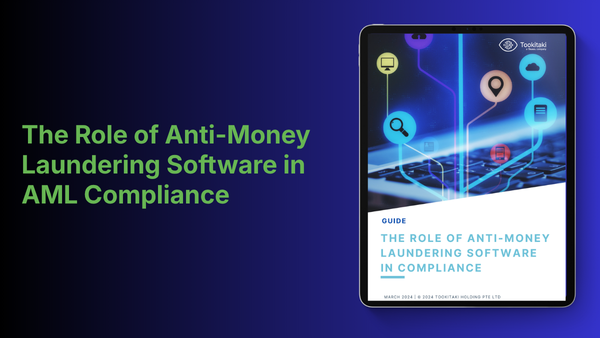
The Role of Anti-Money Laundering Software in AML Compliance
The ebook explains the role of AML software in helping financial institutions meet anti-money laundering compliance requirements more efficiently. It begins by highlighting the scale of money laundering globally and explains why manual AML processes are no longer practical for institutions handling large transaction volumes.
It defines AML software as a technology solution that helps regulated entities prevent, detect, investigate, and report money laundering and related financial crimes. The ebook then breaks down the main capabilities of AML software, including KYC, customer due diligence, name screening, transaction monitoring, transaction screening, case management, and suspicious activity reporting.
A key section focuses on the use of AI in AML compliance, explaining how AI can reduce manual effort, help compliance teams prioritise high-risk alerts, improve process efficiency, and support faster decision-making without replacing human judgement.
The final section introduces Tookitaki’s AML compliance approach, positioning the company’s community-based AFC Ecosystem as a way for financial institutions to detect and prevent financial crime using continuously shared typologies and expert-driven insights.
Overall, the ebook is a concise educational guide on why AML software is essential for modern compliance teams and how AI-powered, community-led solutions can improve financial crime detection and operational efficiency.

Our Thought Leadership Guides
Decoding the AML Risk: Analysis of Singapore’s Money Laundering National Risk Assessment (NRA)
The ebook “Decoding the AML Risk: In-depth Analysis of Singapore’s Money Laundering Risk Assessment 2024” analyses key findings from Singapore’s 2024 Money Laundering National Risk Assessment and explains what they mean for banks, corporate service providers, and fintech payment institutions.
It highlights major risks such as rapid pass-through transactions, misuse of legal entities, organised crime, cyber-enabled fraud, cross-border money movement, and opaque international transfers. The ebook explains that banks face risks from high transaction volumes and account misuse, corporate service providers face risks around shell companies and hidden beneficial ownership, and fintech payment institutions face risks linked to fast cross-border fund flows and digital payment opacity.
A key part of the ebook maps red flags to money laundering risks, including unusual large transactions, rapid movement of funds across jurisdictions, and multiple small transactions below reporting thresholds. It also shares AFC Ecosystem expert insights on why real-time monitoring, stronger CDD/EDD, beneficial ownership transparency, and cross-border compliance are important.
Overall, the ebook positions Singapore’s AML landscape as increasingly complex and globally connected. It argues that financial institutions need stronger monitoring, better risk intelligence, and community-led collaboration through the AFC Ecosystem to keep pace with evolving financial crime threats.

The Sword Tips the Scales: AI and Its Governance
AI has moved from breakthrough to battleground. The Sword Tips the Scales: AI and Its Governance examines the global shift from broad best-practice guidance to harder legal and regulatory accountability, as governments respond to the real-world risks of AI systems. The ebook explores how the EU AI Act is setting a global precedent, why jurisdictions are moving toward stricter oversight, and how the conversation is increasingly centred on responsibility when AI goes wrong.
At the heart of this shift is a deeper question: who is accountable when AI systems hallucinate, fail, or create harm? This ebook unpacks that tension and shows how the burden is no longer falling on users alone. Developers, deployers, and institutions are all being drawn into a new era of governance shaped by transparency, safeguards, explainability, and operational discipline.
The ebook also looks ahead to what this means for financial services. While the sector may not yet be at the centre of AI governance scrutiny, the direction of travel is clear. As regulation matures and modular technology environments become more common, financial institutions and AI providers will face growing pressure to demonstrate control, accountability, and seamless interoperability across systems. The ebook highlights how policies such as AFASA point to this future and why firms should start preparing now.
Download the ebook now to explore the emerging rules of AI governance and what they could mean for trust, accountability, and the future of financial services.
.png)
AML Intelligence Review of Southeast Asia 2025 and the Road Ahead
Financial crime risks across Southeast Asia are evolving faster than traditional AML controls. Rising transaction volumes, real-time payments, and increasingly sophisticated scam and laundering networks are reshaping how risk manifests across banks and payment institutions.
The AML Intelligence Review of Southeast Asia 2025 and the Road Ahead provides a practical view of this shifting landscape. Rather than broad trend commentary, the report examines real AML scenarios deployed by financial institutions across the region, highlighting how alerts behave in practice and where controls begin to fall short.
What the report covers
- Alert behaviour across Southeast Asia
The scenarios generating the highest alert volumes, and why volume alone does not translate into effectiveness. - Operational efficiency gaps
Where detection frameworks struggle despite heavy alerting. - Emerging financial crime patterns
Key developments across scams, laundering, and flow-based risks shaping the region. - The road ahead for AML teams
Why pre-emptive, scenario-driven prevention is becoming essential as risks evolve faster than controls.
Who should read this report
Designed for AML, compliance, and financial crime teams, as well as risk leaders responsible for operations across Southeast Asia.
Why it matters
As financial crime continues to outpace static controls, institutions need clarity on where risk truly accumulates, not just where alerts are triggered. This report delivers focused intelligence to help teams strengthen controls, improve efficiency, and prepare for what lies ahead.

Decoding the AML Risk: Analysis of Singapore’s Money Laundering National Risk Assessment (NRA)
The ebook “Decoding the AML Risk: In-depth Analysis of Singapore’s Money Laundering Risk Assessment 2024” analyses key findings from Singapore’s 2024 Money Laundering National Risk Assessment and explains what they mean for banks, corporate service providers, and fintech payment institutions.
It highlights major risks such as rapid pass-through transactions, misuse of legal entities, organised crime, cyber-enabled fraud, cross-border money movement, and opaque international transfers. The ebook explains that banks face risks from high transaction volumes and account misuse, corporate service providers face risks around shell companies and hidden beneficial ownership, and fintech payment institutions face risks linked to fast cross-border fund flows and digital payment opacity.
A key part of the ebook maps red flags to money laundering risks, including unusual large transactions, rapid movement of funds across jurisdictions, and multiple small transactions below reporting thresholds. It also shares AFC Ecosystem expert insights on why real-time monitoring, stronger CDD/EDD, beneficial ownership transparency, and cross-border compliance are important.
Overall, the ebook positions Singapore’s AML landscape as increasingly complex and globally connected. It argues that financial institutions need stronger monitoring, better risk intelligence, and community-led collaboration through the AFC Ecosystem to keep pace with evolving financial crime threats.

The Sword Tips the Scales: AI and Its Governance
AI has moved from breakthrough to battleground. The Sword Tips the Scales: AI and Its Governance examines the global shift from broad best-practice guidance to harder legal and regulatory accountability, as governments respond to the real-world risks of AI systems. The ebook explores how the EU AI Act is setting a global precedent, why jurisdictions are moving toward stricter oversight, and how the conversation is increasingly centred on responsibility when AI goes wrong.
At the heart of this shift is a deeper question: who is accountable when AI systems hallucinate, fail, or create harm? This ebook unpacks that tension and shows how the burden is no longer falling on users alone. Developers, deployers, and institutions are all being drawn into a new era of governance shaped by transparency, safeguards, explainability, and operational discipline.
The ebook also looks ahead to what this means for financial services. While the sector may not yet be at the centre of AI governance scrutiny, the direction of travel is clear. As regulation matures and modular technology environments become more common, financial institutions and AI providers will face growing pressure to demonstrate control, accountability, and seamless interoperability across systems. The ebook highlights how policies such as AFASA point to this future and why firms should start preparing now.
Download the ebook now to explore the emerging rules of AI governance and what they could mean for trust, accountability, and the future of financial services.
.png)
AML Intelligence Review of Southeast Asia 2025 and the Road Ahead
Financial crime risks across Southeast Asia are evolving faster than traditional AML controls. Rising transaction volumes, real-time payments, and increasingly sophisticated scam and laundering networks are reshaping how risk manifests across banks and payment institutions.
The AML Intelligence Review of Southeast Asia 2025 and the Road Ahead provides a practical view of this shifting landscape. Rather than broad trend commentary, the report examines real AML scenarios deployed by financial institutions across the region, highlighting how alerts behave in practice and where controls begin to fall short.
What the report covers
- Alert behaviour across Southeast Asia
The scenarios generating the highest alert volumes, and why volume alone does not translate into effectiveness. - Operational efficiency gaps
Where detection frameworks struggle despite heavy alerting. - Emerging financial crime patterns
Key developments across scams, laundering, and flow-based risks shaping the region. - The road ahead for AML teams
Why pre-emptive, scenario-driven prevention is becoming essential as risks evolve faster than controls.
Who should read this report
Designed for AML, compliance, and financial crime teams, as well as risk leaders responsible for operations across Southeast Asia.
Why it matters
As financial crime continues to outpace static controls, institutions need clarity on where risk truly accumulates, not just where alerts are triggered. This report delivers focused intelligence to help teams strengthen controls, improve efficiency, and prepare for what lies ahead.