

The QR Code Trap: Why a Simple Scan Is Becoming a Serious Fraud Risk in the Philippines
.svg)
The most dangerous payment scams do not always look suspicious. Sometimes, they look efficient.
A customer scans a QR code at a shop counter, enters the amount, and completes the payment in seconds. There is no failed transaction, no login alert, no obvious red flag. Everything works exactly as it should. Except the money does not go to the merchant. It goes somewhere else. That is the core risk behind the BSP’s recent warning on “quishing,” including cases where a legitimate merchant QR code may be altered, tampered with, or placed over by another code so payments are redirected to a scammer’s account.
At one level, this sounds like a classic consumer-awareness issue. Check the code. Verify the source. Be careful what you scan. All of that is true. But stopping there misses the bigger point. In the Philippines, QR payments are no longer a novelty. They are part of a broader digital payments ecosystem that has scaled quickly, with digital retail payments accounting for 57.4 percent of monthly retail transaction volume, while QR Ph continues to serve as the national interoperable QR standard for participating banks and non-bank e-money issuers.
That changes the conversation.
Because once QR payments become normal, QR fraud stops being a side story. It becomes a payment-risk issue, a merchant-risk issue, and increasingly, a fraud-and-AML issue wrapped into one.

Why this scam matters more than it first appears
What makes QR code scams so effective is not technical sophistication. It is behavioural precision.
Fraudsters do not need to break into a banking app or compromise a device. They simply exploit trust at the point of payment. A sticker placed over a legitimate merchant code can do what phishing links, fake websites, and spoofed calls often try much harder to achieve: redirect money through a transaction the customer willingly authorises. The BSP warning itself highlights the practical advice consumers should follow, including checking whether a QR code appears altered, tampered with, or placed over another code before scanning. That guidance is telling in itself. It signals that physical manipulation of QR payment points is now a live concern.
For professionals in compliance and fraud, that should immediately raise a harder question. If the payment is customer-authorised and the beneficiary account is valid, what exactly is the institution supposed to detect?
The answer is not always the payment instruction itself. It is the pattern surrounding it.
A scam built for a real-time world
The Philippines has spent years building a more interoperable and inclusive digital payments landscape. QR Ph was developed so a common QR code could be scanned and interpreted by any participating bank or non-bank EMI, making person-to-person and person-to-merchant payments easier across providers. That is good infrastructure. It reduces friction, supports adoption, and brings more merchants into the formal digital economy.
But reduced friction has a downside. It also reduces hesitation.
In older payment settings, there were often natural pauses. A card terminal, a manual account check, a branch interaction, a payment slip. QR payments compress that journey. The customer sees the code, scans it, and moves on. That is the whole point of the experience. It is also why this scam is so well suited to modern payment habits.
Criminals have understood something simple: if a system is built around speed and convenience, the easiest place to attack is the moment when people stop expecting to verify anything.
How the QR code scam typically unfolds
The mechanics are almost painfully straightforward.
A fraudster identifies a merchant that relies on a visible static QR code. That could be a stall, a café, a small retail counter, a delivery collection point, or any setup where the code is printed and left on display. The original code is then covered or replaced with another one linked to a scammer-controlled account or a mule account.
Customers continue paying as usual. They do not think they are sending money to an individual or a different beneficiary. They think they are paying the merchant. The merchant, meanwhile, may not realise anything is wrong until expected payments fail to reconcile.
At that point, the payment journey has already begun.
Funds start landing in the receiving account, often in the form of multiple low-value payments from unrelated senders. In isolation, these do not necessarily look suspicious. In fact, they may resemble ordinary merchant collections. That is what makes this scam harder than it sounds. It can create merchant-like inflows in an account that should not really be behaving like a merchant account at all.
Then comes the real risk. The funds are moved quickly. Split across other accounts. Sent to wallets. Withdrawn in cash. Layered through secondary recipients. The initial fraud is simple. The downstream movement can be much more organised.
That is where the scam begins to overlap with laundering behaviour.
Why fraud teams and AML teams should both care
It is easy to classify QR code payment scams as retail fraud and leave it there. That would be too narrow.
From a fraud perspective, the problem is payment diversion. A customer intends to pay a merchant but sends funds elsewhere.
From an AML perspective, the problem is what happens next. Once diverted funds begin flowing into accounts that collect, move, split, and exit value quickly, institutions are no longer looking at a single fraudulent payment. They are looking at a potential collection-and-layering mechanism hidden inside legitimate payment rails.
This matters because the scam does not need large values to become meaningful. A QR fraud ring does not need one massive transfer. It can rely on volume, repetition, and velocity. Small payments from many victims can create a steady stream of illicit funds that looks unremarkable at transaction level but far more suspicious in aggregate.
That is why the typology deserves more serious treatment. It lives in the overlap between fast payments, mule-account behaviour, and low-friction laundering.
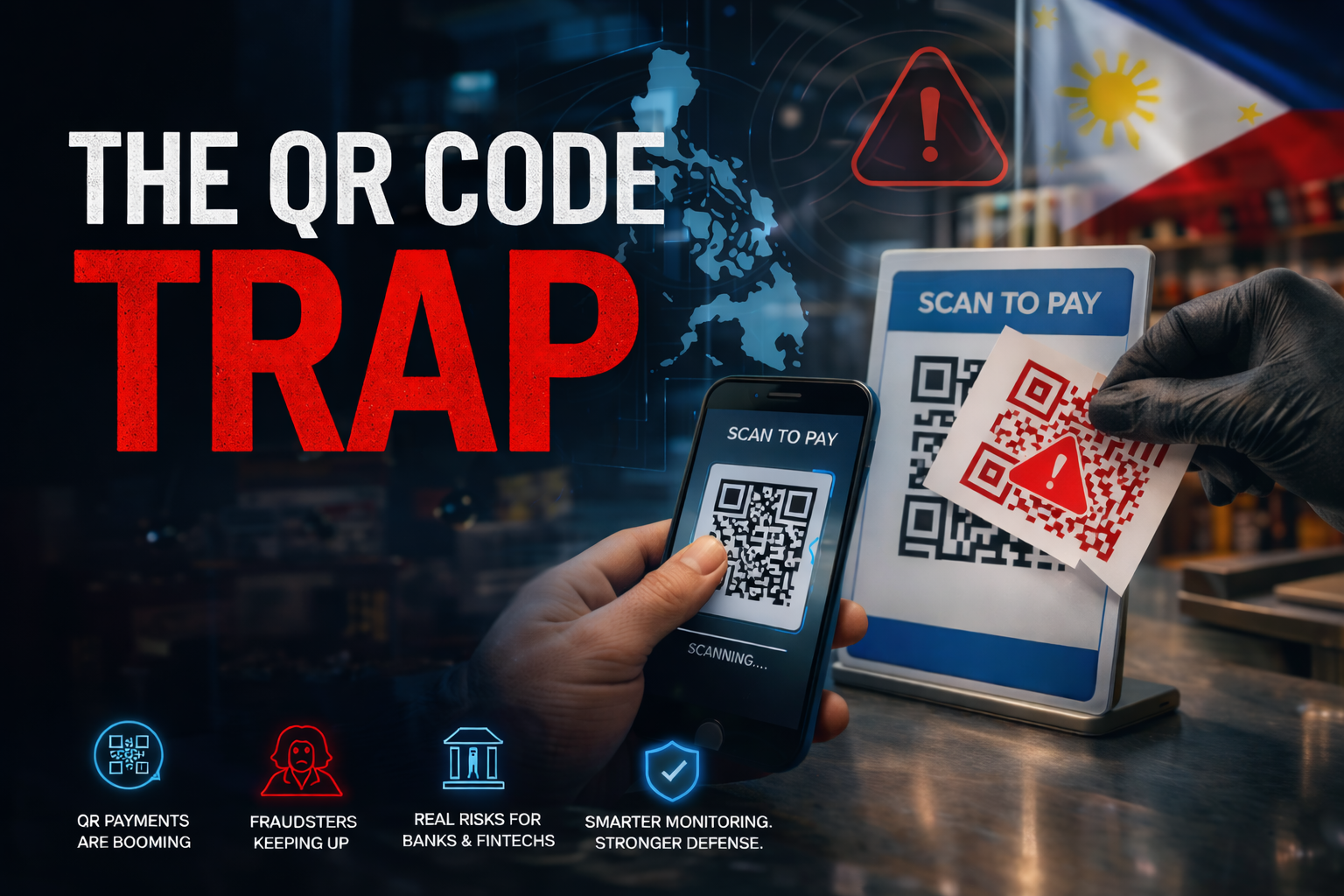
The detection challenge is not the scan. It is the behaviour after the scan.
Most legacy controls were not built for this.
Traditional monitoring logic often performs best when something is clearly out of character: an unusually large transaction, a high-risk jurisdiction, a sanctions hit, a known suspicious counterparty, or a classic account takeover pattern. QR scams may present none of those signals at the front end. The customer has not necessarily been hacked. The payment amount may be ordinary. The transfer rail is legitimate. The receiving account may not yet be watchlisted.
So the wrong question is: how do we detect every suspicious QR payment?
The better question is: how do we detect an account whose behaviour no longer matches its expected role?
That is a much more useful lens.
If a newly opened or low-activity account suddenly begins receiving merchant-like inbound payments from many unrelated individuals, that should matter. If those credits are followed by rapid outbound transfers or repeated cash-out behaviour, that should matter more. If the account sits inside a broader network of linked beneficiaries, shared devices, repeated onward transfers, or mule-like activity patterns, then the case becomes stronger still.
In other words, the problem is behavioural inconsistency, not just transactional abnormality.
Why this is becoming a real-time monitoring problem
This scam is particularly uncomfortable because it plays out at the speed of modern payments.
The BSP’s own digital payments reporting shows how mainstream digital retail payments have become in the Philippines. When money moves that quickly through interoperable rails, institutions lose the luxury of treating suspicious patterns as something to review after the fact. By the time a merchant notices missing collections, an operations team reviews exceptions, or a customer dispute is logged, the funds may already have been transferred onward.
That shifts the burden from retrospective review to timely pattern recognition.
This is not about flagging every small QR payment. That would be unworkable and noisy. It is about identifying where a stream of seemingly routine payments is being routed into an account that starts exhibiting the wrong kind of velocity, concentration, or onward movement.
The intervention window is narrow. That is what makes this a real-time problem, even when the scam itself is physically low-tech.
The merchant ecosystem is an exposed surface
There is also a more uncomfortable operational truth here.
QR-based payment growth often depends on simplicity. Merchants, especially smaller ones, benefit from static printed codes that are cheap, easy to display, and easy for customers to use. But static codes are also easier to tamper with. In some environments, a fraudster does not need cyber capability. A printed overlay is enough.
That does not mean QR adoption is flawed. It means the ecosystem carries a visible attack surface.
The BSP and related QR Ph materials have consistently framed QR Ph as a way to make digital payments interoperable and more convenient for merchants and consumers, including smaller businesses and users beyond traditional card acceptance footprints. That inclusion benefit is real. It is also why institutions need to think carefully about what fraud controls look like when convenience extends to low-cost, visible, physically accessible payment instruments.
In plain terms, if the front-end payment instrument can be tampered with in the real world, then the back-end monitoring has to be smarter.
What better monitoring looks like in practice
The right response to this typology is not a flood of rules. It is a better sense of account behaviour, role, and connected movement.
Institutions should be asking whether they can tell the difference between a genuine merchant collection profile and a personal or mule account trying to imitate one. They should be able to examine how quickly inbound funds are moved onward, whether those patterns are sudden or sustained, whether counterparties are unusually diverse, and whether linked accounts show signs of coordinated activity.
They should also be able to connect fraud signals and AML signals instead of treating them as separate universes. In a QR diversion case, the initial trigger may sit with payment fraud, but the onward flow often sits closer to mule detection and suspicious movement analysis. If those two views are not connected, the institution sees only fragments of the story.
That is where stronger case management, behavioural scoring, and scenario-led monitoring become important.
And this is exactly why Tookitaki’s positioning matters in a case like this. A typology such as QR payment diversion does not demand more noise. It demands better signal. It demands the ability to recognise when an account is behaving outside its expected role, when transaction velocity starts to look inconsistent with ordinary retail activity, and when scattered data points across fraud and AML should really be read as one emerging pattern. For banks and fintechs dealing with increasingly adaptive scams, that shift from isolated alerting to connected intelligence is not a nice-to-have. It is the difference between seeing the payment and seeing the scheme.
A small scam can still reveal a much bigger shift
There is a tendency in financial crime writing to chase the dramatic case. The million-dollar fraud. The cross-border syndicate. The major arrest. Those stories matter, but smaller scams often tell you more about where the system is becoming vulnerable.
This one does exactly that.
A QR code replacement scam is not flashy. It is not technically grand. It may even look mundane compared with deepfakes, synthetic identities, or complex APP fraud chains. But it tells us something important about the current payments environment: fraudsters are increasingly happy to exploit trust, convenience, and physical access instead of sophisticated intrusion. That is not backward. It is efficient.
And for institutions, efficiency is exactly what makes it dangerous.
Because if a criminal can redirect funds without stealing credentials, without breaching an app, and without triggering an obvious failure in the payment experience, then the burden of defence shifts downstream. It shifts to monitoring, behavioural intelligence, and the institution’s ability to recognise when a legitimate payment journey has produced an illegitimate result.
Conclusion: the payment worked, but the control failed
That is the real sting in this typology.
The payment works. The rails work. The customer experience works. What fails is the assumption underneath it.
The BSP’s recent warning on quishing should be read as more than a consumer caution. It is a signal that as digital payments deepen in the Philippines, some of the next fraud risks will come not from breaking the payment system, but from quietly misdirecting trust within it.
For compliance teams, fraud leaders, and risk professionals, the lesson is clear. The problem is no longer limited to whether a transaction was authorised. The harder question is whether the institution can recognise, early enough, when a transaction that looks routine is actually the first step in a scam-and-laundering chain.
That is what makes this worth paying attention to.
Not because it is dramatic.
Because it is plausible, scalable, and built for the exact kind of payment environment the industry has worked so hard to create.
Experience the most intelligent AML and fraud prevention platform
Experience the most intelligent AML and fraud prevention platform
Experience the most intelligent AML and fraud prevention platform
Top AML Scenarios in ASEAN
The Role of AML Software in Compliance
The Role of AML Software in Compliance
Talk to an Expert
Our Thought Leadership Guides

KYC Requirements for Philippine Banks: AMLA, BSP obligations, and What Compliance Teams Need to Know in 2026
The Philippines was removed from the FATF list of jurisdictions under increased monitoring in February 2025. This guide explains current AMLA and BSP KYC/CDD requirements for banks, including beneficial ownership, digital onboarding, reporting and record retention.
KYC Requirements for Philippine Banks: AMLA, BSP obligations, and What Compliance Teams Need to Know in 2026
The Philippines was removed from the FATF list of jurisdictions under increased monitoring in February 2025. This guide explains current AMLA and BSP KYC/CDD requirements for banks, including beneficial ownership, digital onboarding, reporting and record retention.