

From Phone Scam to Gold Bars: How Thailand’s Call-Centre Gang Broke the Money Trail
.svg)
A forged court order can trigger the scam. A mule account can receive the money. But the real AML risk becomes clearer when stolen funds are converted into gold bars, smartphones and other portable assets before being moved offshore.
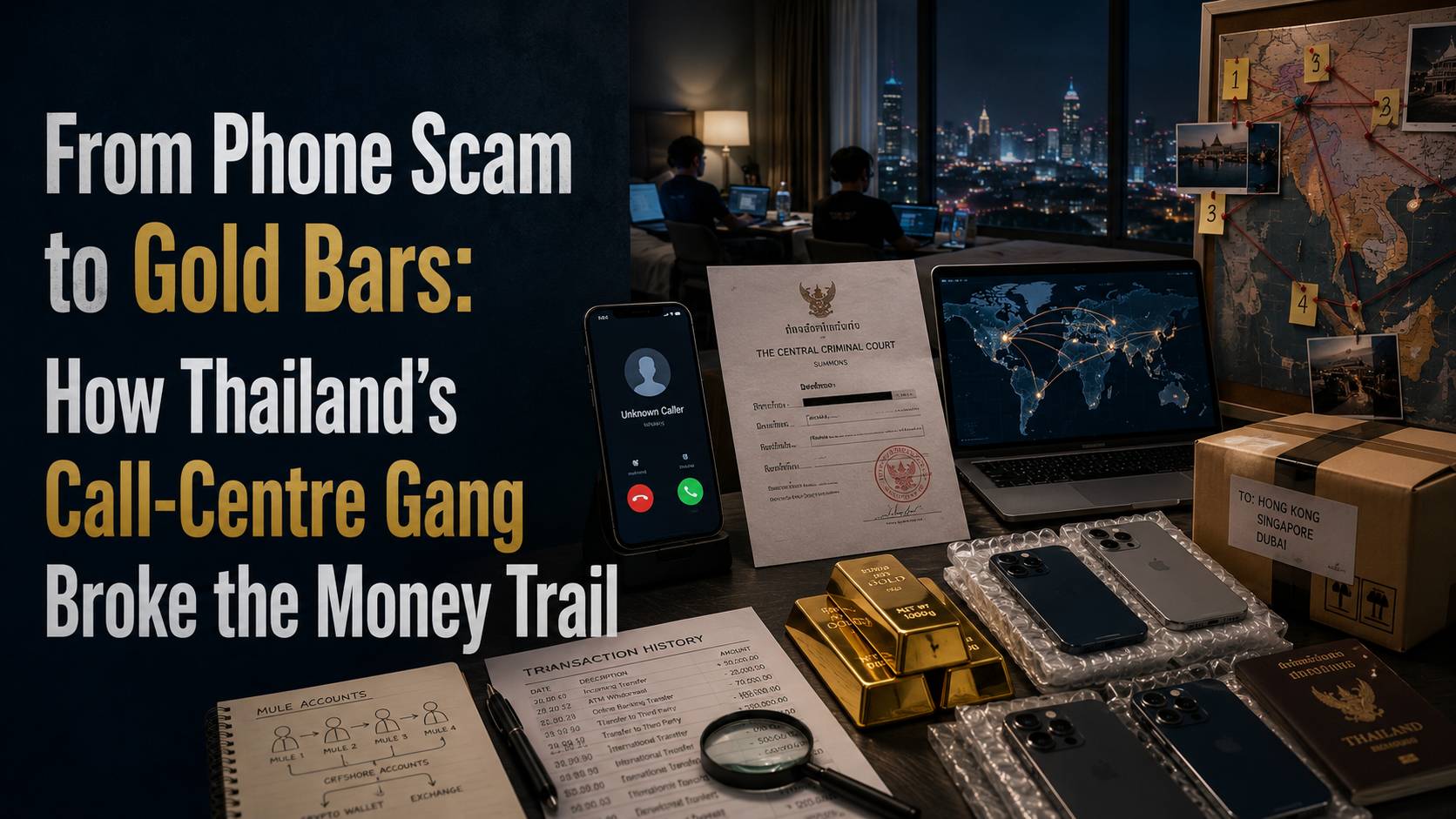
That is the key lesson from a recent Thailand case, where police arrested four Vietnamese nationals in linked scam, money laundering and bribery investigations. Thai police said tracing money flows from a crystal-methamphetamine case led investigators to a transnational call-centre scam network. Officers seized gold bars, gold jewellery, latest-model iPhones and other assets, and said the group converted fraud proceeds into gold before moving them abroad.
At first glance, this may look like a phone-scam case involving impersonation and intimidation. But for banks, payment firms, e-wallets, remittance providers, gold dealers and compliance teams, the broader issue is how fraud proceeds can move from a victim account into mule accounts, then into high-value portable assets, and eventually across borders.
The scam may start with a phone call. The AML risk begins when the money trail is cut.

What Happened in the Thailand Call-Centre Scam Case?
According to The Star, Thai Metropolitan Police said they uncovered the network after tracing money flows from a drug case involving crystal methamphetamine hidden in parcel boxes sent to Japan, as well as an online scam involving a student who was deceived into faking their own kidnapping for ransom. Investigators later found that cash had been converted into gold bars and mobile phones.
Police said the group had divided its duties systematically, concealed its operations and stayed together at a hotel in the Nawamin area of Ram Inthra subdistrict, Bueng Kum district, Bangkok. Officers raided the hotel and arrested three Vietnamese suspects. They also seized a document recording a transaction for 40 baht-weight of gold, which was to be used to collect gold from a shop, along with several smartphones.
The victim in the call-centre scam was allegedly contacted by people impersonating a telecommunications company employee and a police officer from Mueang Ranong Police Station. The scammers claimed that the victim’s identity card had been used to open a bank account linked to money laundering. They then sent a forged court order and threatened the victim into transferring money to “prove their innocence”. The victim transferred THB 200,000 to a mule account used by the group.
The case also widened into a bribery investigation. While three suspects were being questioned, a Vietnamese woman allegedly arrived at the police station with THB 150,000 and attempted to bribe officers for help with the case. She was arrested in a sting operation and charged with bribing a public official.
For financial institutions, the case is important because it shows a full chain of risk: impersonation, victim coercion, mule-account collection, asset conversion, possible offshore movement and alleged bribery. Each stage may involve different actors, accounts, channels and control points.
Why This Matters for Thai Financial Institutions
Thailand, like many markets in the region, sits within a fast-moving financial environment where bank transfers, wallets, remittances, digital platforms and cash-based channels can interact quickly. This connectivity helps customers, but it can also be exploited by organised scam networks that need to collect funds, break the trail and move value across borders.
In this case, the scam narrative was built around fear and authority. The victim was allegedly told that their identity had been misused in a money laundering matter and was then pressured into transferring funds. This type of impersonation scam is dangerous because the victim may authorise the payment under pressure, believing they are cooperating with law enforcement.
For financial institutions, that creates a difficult detection challenge. A customer may pass authentication checks. The payment may be initiated voluntarily. The amount may not always be large enough to trigger a simple threshold alert. But the beneficiary account, timing, transaction purpose and onward movement may show a very different picture.
The deeper AML concern is what happens after the payment lands. In this case, police said the network’s role included converting fraud cash into gold and mobile phones before sending assets to beneficiaries in Vietnam. This points to a typology where illicit funds do not remain in the banking system for long. They may be rapidly transformed into portable stores of value that are harder to trace than account-to-account transfers.
How Phone Scams Become AML Risks
Phone scams often begin outside the banking system, but the proceeds usually need financial channels to be collected, layered or converted. The victim may be manipulated through fear, urgency or false authority. Once funds are transferred, the scam becomes an AML concern because the proceeds may enter accounts or wallets controlled by mules, intermediaries or organised networks.
A typical pathway may involve a victim transferring money to a mule account after being threatened or deceived. The mule account may then move funds quickly to another account, withdraw cash, make purchases, transfer funds to a handler, or convert money into assets such as gold, luxury goods, electronics or digital assets. These assets may then be handed to couriers, sold, moved across borders or used to settle obligations within a wider criminal network.
The Thailand case illustrates this risk clearly. Police said the victim transferred THB 200,000 to a mule account, while investigators later found evidence of cash being converted into gold bars and mobile phones. One suspect reportedly told investigators she had been paid to travel, buy gold and collect mobile phones based on instructions received through Telegram.
For compliance teams, this means scam monitoring cannot stop at the first victim payment. Institutions need to understand the full lifecycle of the funds: who received the money, how quickly it moved, whether it was withdrawn or converted, and whether related accounts show similar behaviour.
Mule Accounts, Gold Conversion and Offshore Movement
The most important AML feature in this case is the conversion of funds into portable assets. Gold bars, jewellery and high-value smartphones can serve as compact stores of value. They can be purchased quickly, moved physically, handed to another party or sent across borders. This makes them attractive for criminal networks that want to reduce reliance on traceable bank transfers.
Police said the network converted cash obtained through fraud into assets that were difficult to trace, cutting the financial trail before moving them out of the country. They also said the assets were intended for beneficiaries in Vietnam.
This creates monitoring challenges across multiple sectors. Banks and payment firms may see the initial mule-account activity. Gold dealers may see high-value purchases funded by transfers or cash. Remittance providers may see cross-border movement. Mobile phone retailers may see bulk or repeated purchases of expensive devices. No single institution may see the entire pattern unless signals are connected.
For banks, the red flag may be an account receiving scam proceeds and rapidly transferring funds to a gold shop or withdrawing cash. For gold dealers, the red flag may be repeated purchases by individuals with no clear source of funds or purchases funded by third parties. For remittance providers, the red flag may be outgoing transfers following recent scam-linked inflows or asset sales. For investigators, the strongest signal may be the network: shared devices, repeated beneficiaries, common handlers, Telegram instructions, recurring gold-shop activity and links to offshore recipients.
Red Flags Banks, Wallets and Payment Firms Should Monitor
Cases like this can generate warning signs across customer behaviour, beneficiary activity, account movement and asset conversion.
Key red flags may include:
- Customers making urgent transfers after receiving calls from alleged officials, police, telecoms employees or government representatives
- Payment reasons linked to “verification”, “proving innocence”, “clearing an investigation”, “court order”, “frozen account” or similar pressure-based explanations
- Funds transferred to newly added beneficiaries with no clear relationship to the sender
- Mule accounts receiving credits from unrelated individuals and moving funds onward quickly
- Rapid withdrawals, fund splitting or transfers to third parties shortly after receipt
- Transfers from mule-like accounts to gold shops, jewellery dealers, electronics retailers or high-value goods merchants
- Repeated purchases of gold bars, gold jewellery, smartphones or other portable assets that are inconsistent with the customer profile
- Accounts or wallets linked by the same phone number, device, IP address, address, introducer, beneficiary or cash-out pattern
- Cross-border remittances or asset-related payments soon after suspicious inbound transfers
- Customers unable to explain the source, purpose, beneficiary relationship or economic rationale behind the transaction
Individually, some of these signals may not prove wrongdoing. Together, they may indicate that scam proceeds are being collected, converted and moved through a wider laundering network.
The strongest signal is rarely one transaction. It is the pattern across victim behaviour, mule accounts, merchant payments, asset purchases, beneficiaries and offshore movement.
Why Traditional Monitoring May Miss the Risk
Traditional transaction monitoring may struggle with this type of scam because the first payment may look authorised. The victim may personally initiate the transfer and may even confirm it if contacted by the bank. If the transaction amount is not unusually high, and if the receiving account has not yet been flagged, a rules-based system may not immediately detect the risk.
The laundering pattern may also move quickly across sectors. A bank may only see the victim-to-mule transfer. A gold shop may only see the purchase. A remittance provider may only see the later outbound movement. If these signals remain separate, the network can appear fragmented and low risk.
This is why simple threshold rules are not enough. The risk becomes clearer when institutions connect customer behaviour, beneficiary risk, transaction velocity, merchant category, cash-out activity, shared identifiers, adverse intelligence and cross-border movement.
For example, one transfer to a new beneficiary may not look suspicious. But if that beneficiary receives funds from multiple unrelated senders, quickly transfers money to a gold shop, shares identifiers with other flagged accounts, and has links to offshore recipients, the risk profile changes significantly.
The scam begins with a story. The laundering pattern appears in the movement.
Why Fraud, AML and Investigations Teams Need a Shared View
This case sits at the intersection of fraud, AML, narcotics-linked money flows, bribery risk and transnational organised crime. The fraud team may see the victim complaint. The AML team may see mule-account behaviour. The investigations team may see links to gold purchases, smartphones or offshore beneficiaries. The screening team may identify adverse intelligence. Law enforcement may uncover connections to drug trafficking or bribery.
If these signals sit in separate systems, institutions may see only fragments of the risk. A victim payment may look authorised. A mule account may look like a low-value personal account. A gold purchase may look like normal retail activity. A remittance may look like a routine cross-border transfer. But together, these signals may point to an organised network converting scam proceeds into portable assets.
A shared view helps financial institutions understand both sides of the case: the customer who was deceived and the account or network that may be receiving and moving the proceeds. This is especially important when scams involve multiple predicate risks, such as fraud, narcotics-linked money movement, bribery and cross-border laundering.
For compliance teams, the key question is not only whether a transaction crossed a threshold. It is whether the customer, beneficiary, merchant activity and onward movement make sense together.
What This Means for Compliance Teams
For compliance teams in Thailand and across the region, this case highlights three practical priorities.
First, institutions should strengthen scam and mule-account monitoring around authority impersonation typologies. Payments made under pressure to “prove innocence”, clear an investigation or comply with an alleged court order should be treated as high-risk behavioural indicators, especially when the beneficiary is new or unrelated.
Second, institutions should watch for asset-conversion patterns. Transfers to gold dealers, jewellery shops, electronics retailers or high-value merchants shortly after suspicious inbound credits can indicate that proceeds are being converted into portable value. This is particularly important when account activity is inconsistent with the customer’s profile.
Third, institutions should use network-level analytics to connect related accounts and channels. Shared devices, phone numbers, IP addresses, addresses, common beneficiaries, merchant links and rapid cash-out behaviour can reveal laundering networks that are not visible through individual alerts.
The broader message is that scam proceeds do not always remain as cash or bank balances. They may quickly become gold, phones, luxury goods or other assets that can be moved outside the financial system. Compliance teams need controls that can detect this transition early.
How Tookitaki Helps Financial Institutions Detect These Patterns
Tookitaki helps financial institutions move beyond isolated alerts to a more connected view of scam, mule and AML risk.
FinCense brings together customer risk, transaction monitoring, screening, alert management and case investigation so compliance teams can identify suspicious patterns across customers, accounts, beneficiaries, counterparties, merchants and fund flows.
In cases involving phone scams, mule accounts and asset conversion, the risk may appear through a combination of signals: victim-authorised transfers under pressure, new beneficiary activity, mule-like inflows, rapid onward movement, transfers to gold or electronics merchants, shared identifiers, cross-border movement, adverse intelligence and links to known scam typologies.
FinCense helps institutions connect these signals, prioritise higher-risk alerts and give investigators a clearer view of the network behind the activity. Through the AFC Ecosystem, Tookitaki also helps institutions stay closer to emerging typologies involving impersonation scams, mule accounts, scam proceeds, asset conversion, cross-border layering, gold-related laundering and transnational organised crime.
The objective is not to generate more alerts. It is to detect the right patterns earlier, identify connected accounts and support faster investigation outcomes.
The Bigger Lesson: When Money Becomes Gold, the Trail Can Disappear
The Thailand call-centre scam case shows how quickly financial crime can move from deception to laundering. A victim may receive a frightening phone call. A forged court order may create urgency. A mule account may receive the transfer. Within a short period, the proceeds may be converted into gold bars, smartphones or other portable assets and prepared for offshore movement.
For financial institutions, the lesson is clear. Scam detection must extend beyond the victim payment. It must follow the funds into the next stage of the laundering chain.
The call may be fake. The court order may be forged. But the money movement is real, and it can leave patterns across accounts, merchants, assets and borders.
Compliance teams do not need to know every scam script to detect the risk. They need to recognise when the money trail is being broken.
Experience the most intelligent AML and fraud prevention platform
Experience the most intelligent AML and fraud prevention platform
Experience the most intelligent AML and fraud prevention platform
Top AML Scenarios in ASEAN
The Role of AML Software in Compliance
The Role of AML Software in Compliance
Talk to an Expert
Our Thought Leadership Guides


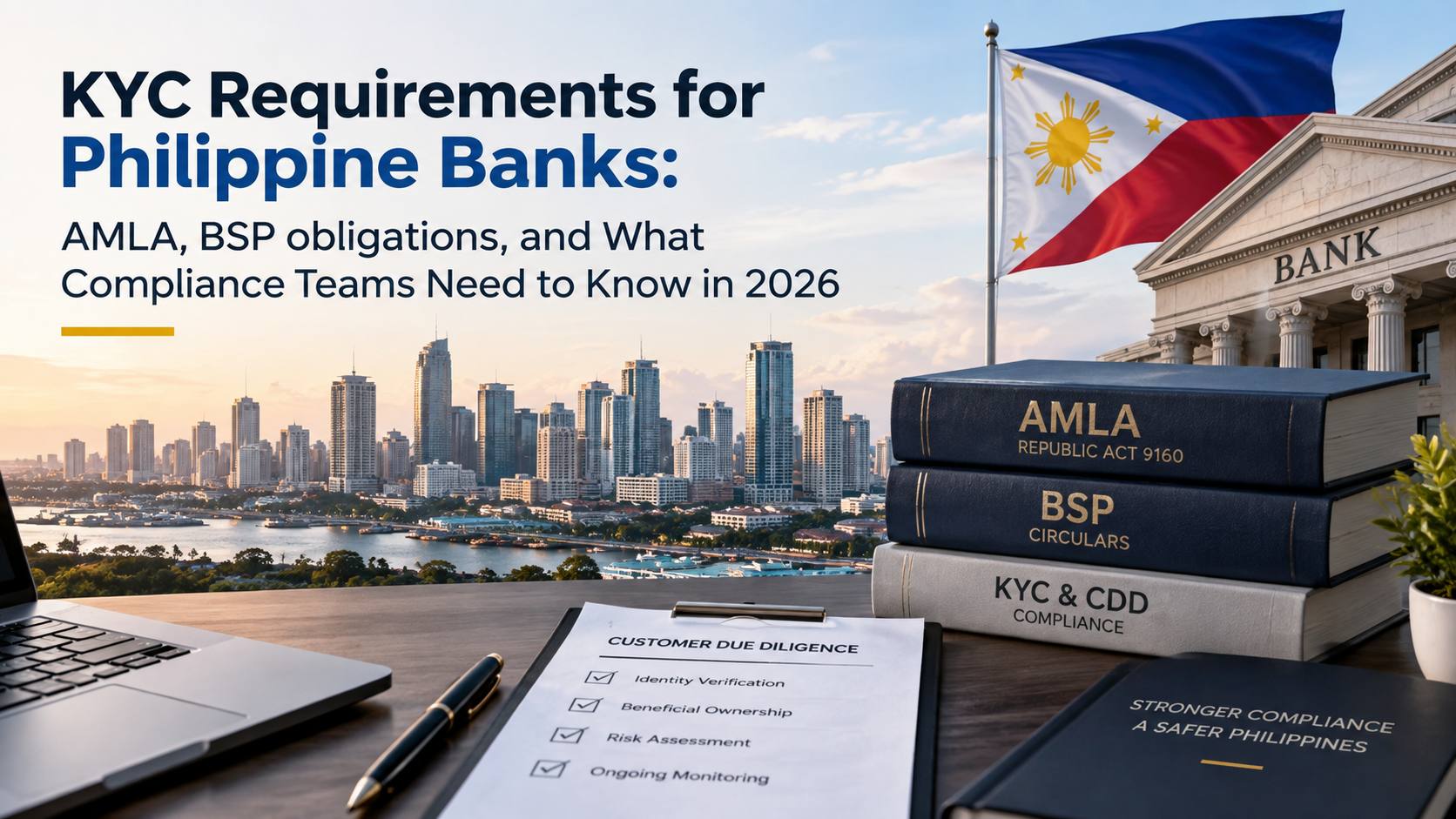
KYC Requirements for Philippine Banks: AMLA, BSP obligations, and What Compliance Teams Need to Know in 2026
The Philippines was removed from the FATF list of jurisdictions under increased monitoring in February 2025. This guide explains current AMLA and BSP KYC/CDD requirements for banks, including beneficial ownership, digital onboarding, reporting and record retention.
KYC Requirements for Philippine Banks: AMLA, BSP obligations, and What Compliance Teams Need to Know in 2026
The Philippines was removed from the FATF list of jurisdictions under increased monitoring in February 2025. This guide explains current AMLA and BSP KYC/CDD requirements for banks, including beneficial ownership, digital onboarding, reporting and record retention.