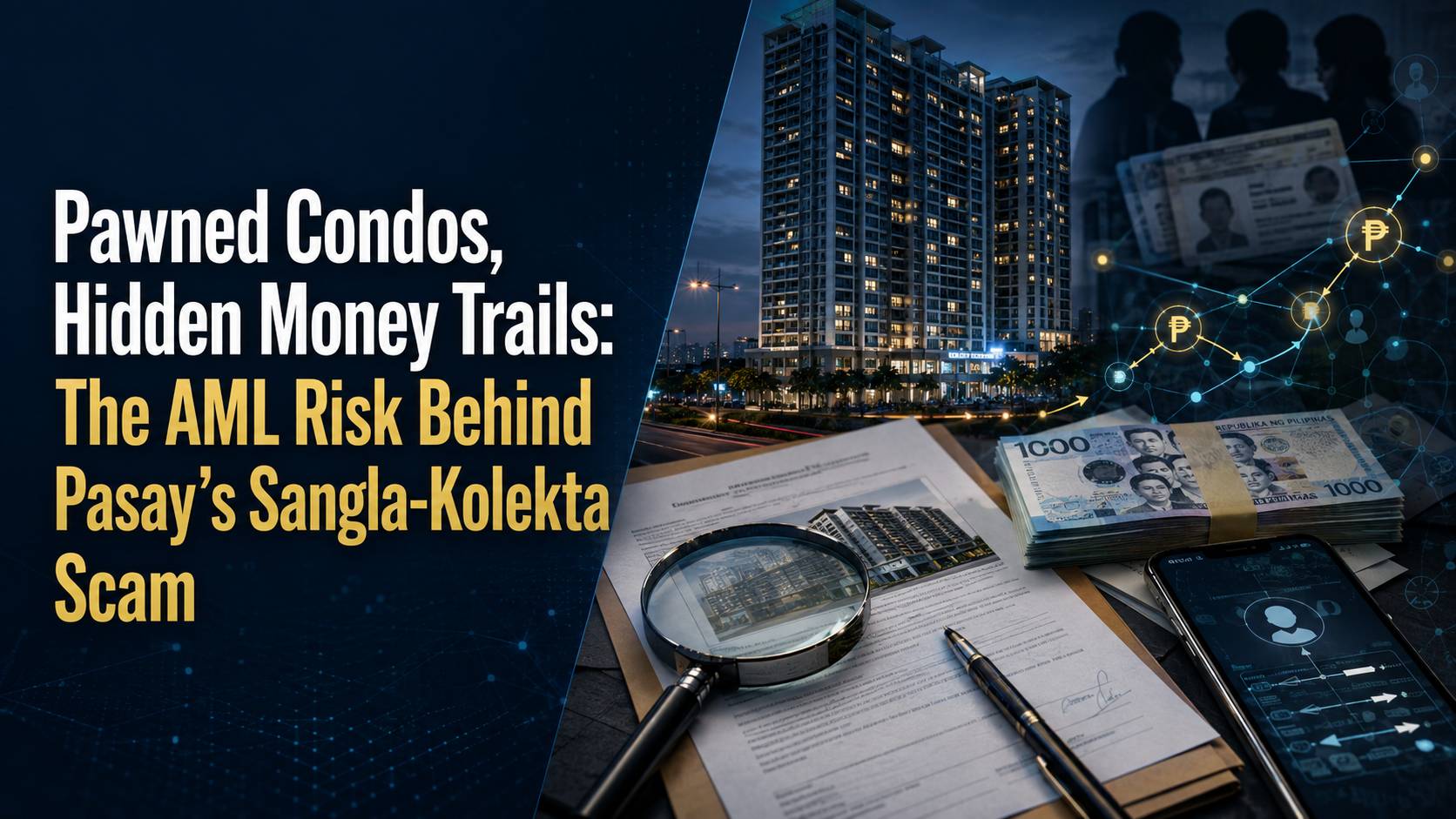
Pawned Condos, Hidden Money Trails: The AML Risk Behind Pasay’s Sangla-Kolekta Scam
.svg)
The promise was simple: put money into a condominium-linked arrangement and collect rental income.
But when the property claim is false, the financial crime risk does not end with the victim’s loss. It begins when the proceeds are collected, withdrawn, transferred or channelled through accounts, cash and connected parties.
That is the key AML lesson from a recent sangla-kolekta, or pawn-and-collect, condominium scam case in Pasay City. According to reports, Southern Police District officers arrested two men on 17 August 2026 after they allegedly posed as condominium owners and tried to obtain PHP 364,000 from a victim through a fraudulent loan and condominium rental agreement. The victim had already lost PHP 300,000 before coordinating with police for an entrapment operation involving an additional PHP 64,000 in marked money.
At first glance, this may look like a property scam involving fake ownership. But for banks, e-wallets, payment firms and compliance teams, the bigger question is what happens after the money is collected. Were the proceeds kept in cash, deposited into personal accounts, moved through mule accounts, transferred to connected parties, or layered through other transactions?
The scam may begin with a fake property claim. The AML risk begins when the money starts moving.

What Happened in Pasay City?
The case involved two men who allegedly posed as condominium owners in Pasay City. According to the Southern Police District, the suspects were apprehended inside a mall restaurant at around 11:20 p.m. on 17 August 2026 after accepting marked money during an entrapment operation.
The operation began after a 33-year-old victim filed a complaint. The victim had allegedly lost an initial PHP 300,000 under a fraudulent loan and condominium rental agreement. After checking the property, the victim discovered that the suspects were not the registered owners of the condominium unit.
The victim then coordinated with police and arranged a follow-up meeting under the pretence of handing over an additional PHP 64,000 investment. When the suspects accepted the marked money, police operatives moved in and arrested them. Officers recovered the marked cash, several identification cards and two smartphones used in the transaction.
Police said formal estafa complaints were being prepared for inquest proceedings. The Southern Police District also warned prospective renters and investors to verify property ownership directly with official building management before entering into financial agreements.
The National Bureau of Investigation has previously explained that under a sangla-kolekta scam, fraudsters posing as property owners or agents offer victims a mortgaged residential property. In exchange for their cash investment, victims are promised monthly rental income supposedly collected from tenants. After receiving the payout, scammers typically disappear and cut contact.
For financial institutions, this matters because the scam is not only about misrepresentation at the point of sale. It is also about how the proceeds are received, stored, moved and potentially disguised after the victim pays.
Why This Matters for Philippine Financial Institutions
Property-linked scams can be difficult to detect because the payment story may sound plausible. A victim may believe they are entering into a rental-income arrangement, loan agreement, mortgage-linked transaction or informal property investment. The transfer may be authorised, supported by conversations, identification cards or property-related documents, and framed as a legitimate financial arrangement.
For banks and payment firms, the issue is not only whether the sender approved the payment. It is whether the recipient account, cash collection pattern, documentation, property claim and onward movement make sense together.
A single payment to an individual may not look unusual. But if the receiving party collects funds from multiple unrelated people, uses property-linked narratives, moves money quickly, or routes funds into connected accounts, the pattern may indicate a wider scam collection operation.
This is why sangla-kolekta cases should not be viewed only as property fraud. Once victim funds enter bank accounts, wallets or cash-out channels, the case can become an AML concern. The proceeds may be moved, layered or disguised before the victim discovers that the ownership claim was false.
For Philippine banks, wallets, payment firms and remittance providers, the risk sits at the point where victim-authorised payments become suspicious proceeds.
How Property-Linked Scams Create AML Risk
Property scams often borrow credibility from real assets. A condominium unit, rental agreement, mortgage arrangement or tenant-income promise can make a transaction appear grounded in legitimate economic activity.
In a sangla-kolekta arrangement, the victim may be told that their money is secured against a property or that they will earn from rental collections. This can create a false sense of safety. The problem arises when the person offering the arrangement is not the true owner, has no authority over the property, or is using documents and conversations to create a misleading investment story.
From an AML perspective, the risk begins when the proceeds are received. Funds collected from victims may be kept in cash, deposited into personal accounts, transferred to associates, used for expenses, moved to other accounts, or withdrawn before complaints are filed. If the scam involves several victims, the same receiving account or connected group of accounts may show repeated inflows under similar property-linked explanations.
This is where fake ownership, cash collection and mule-account risk can overlap. Reports said the victim discovered that the suspects were not the registered owners after verifying the condominium unit with management. In the entrapment operation, the suspects allegedly accepted PHP 64,000 in marked money before being arrested.
Cash can make tracing more difficult, especially when proceeds are later deposited, split, spent or transferred through accounts not clearly linked to the original scam. Mule-account risk may also arise where personal accounts are used by suspects, associates, relatives or third parties to receive and move funds.
The key AML issue is not only who made the false promise. It is who received the money, where it went next, and whether that movement matches any legitimate economic rationale.
Red Flags Banks, Wallets and Payment Firms Should Monitor
Sangla-kolekta and property-linked scams can generate warning signs across onboarding, payments, account behaviour and investigations.
Key red flags may include:
- Customers receiving property-related payments despite having no clear real estate, rental or lending profile
- Multiple inbound transfers from unrelated individuals with references to condo, rent, collateral, loan, investment, collection or property income
- Personal accounts receiving large or repeated payments inconsistent with the customer’s occupation, income or expected activity
- Funds moving quickly after receipt through withdrawals, transfers to third parties or payments to connected accounts
- Customers using different names, identification cards, phone numbers or accounts across property-related transactions
- Payment activity linked to informal investment, rental-income or loan arrangements without clear supporting documentation
- Accounts connected to multiple complaints, chargebacks, fraud reports or law-enforcement enquiries
- Shared devices, addresses, mobile numbers or beneficiaries across accounts receiving similar property-linked payments
- Customers unable to explain the ownership, authority, purpose or end beneficiary behind received funds
Individually, some of these signals may not prove wrongdoing. Together, they may indicate that an account is being used to collect, move or disguise proceeds from a property-linked scam.
The strongest signal is often the mismatch between the claimed property arrangement and the actual customer, account and fund-flow behaviour.
Why Traditional Monitoring May Miss the Risk
Traditional transaction monitoring may miss property-linked scams because the payments can appear legitimate when viewed in isolation. A victim may authorise the payment. The recipient may be an individual with a valid account. The stated purpose may sound like rent, collateral, a loan agreement or a property investment.
If monitoring relies mainly on thresholds, known blacklists or simple transaction rules, the deeper risk may not be detected early. The receiving account may not have a prior risk history. The scam may involve only a few victims at first. The payment may also be supported by messages or documents that appear credible to the victim.
The risk becomes clearer when institutions connect multiple signals, including sender diversity, transaction descriptions, recipient profile, ownership claims, sudden account activity, rapid onward movement, repeated property-linked explanations, linked devices and complaint history.
For example, one payment described as a property loan may not appear suspicious. But if the same beneficiary receives multiple payments from unrelated individuals, has no real estate profile, moves funds out quickly and is linked to complaints about false ownership claims, the risk profile changes.
This is why scam and AML monitoring must look beyond the first authorised payment. It needs to understand behaviour, relationships, purpose and movement.
Why Fraud, AML and KYC Teams Need a Shared View
Sangla-kolekta scams sit at the intersection of fraud, KYC, transaction monitoring and investigations.
The fraud team may see the victim complaint. The KYC team may hold the recipient’s occupation, address and customer profile. The AML team may see unusual inflows or rapid movement. The payments team may see repeated transfers from unrelated senders. Investigators may identify shared phone numbers, devices, documents or beneficiaries.
If these signals remain separate, the institution may only see fragments of the risk. A payment may look authorised. A recipient account may appear normal. A customer profile may not immediately suggest financial crime. But when the signals are connected, the same activity may point to a scam proceeds account or a wider collection network.
A shared view helps compliance teams understand both sides of the transaction: the victim who believes they are entering a property-linked agreement, and the beneficiary who may be collecting or moving the proceeds.
This matters because property-linked scams do not stop being a fraud issue after the payment is made. Once funds are received, transferred, withdrawn or layered, they can become an AML issue that requires investigation, escalation and possible reporting.
What This Means for Compliance Teams
For compliance teams in the Philippines, the Pasay case reinforces three practical priorities.
First, institutions should strengthen beneficiary-level monitoring. Scam detection should not focus only on the sender. Receiving accounts that collect funds from unrelated individuals, show sudden inflows or move proceeds quickly should be reviewed for scam collection behaviour.
Second, institutions should examine whether property-related payment explanations align with the customer profile. If a personal account receives funds described as rent, loan, collateral or property investment, but the customer has no apparent property business or ownership link, the transaction deserves closer scrutiny.
Third, institutions should use network-level analysis to detect connected accounts and repeated patterns. Shared phones, devices, addresses, IDs, beneficiaries or complaint links can reveal organised activity that may not be visible in one customer file.
The broader message is that property-linked fraud can create legitimate-looking payment narratives. Compliance teams need controls that can test whether those narratives match the actual money movement.
How Tookitaki Helps Financial Institutions Detect These Patterns
Tookitaki helps financial institutions move beyond isolated alerts to a more connected view of scam, mule and AML risk.
FinCense brings together customer risk, transaction monitoring, screening, alert management and case investigation so compliance teams can identify suspicious patterns across customers, accounts, beneficiaries, counterparties and fund flows.
In property-linked scam cases, the risk may appear through a combination of signals: repeated payments from unrelated victims, suspicious property-related references, inconsistent customer profiles, rapid onward movement, shared identifiers, linked beneficiaries, complaint history and account networks that show mule-like behaviour.
FinCense helps institutions connect these signals, prioritise higher-risk alerts and give investigators a clearer view of the customer and network behind the activity. Through the AFC Ecosystem, Tookitaki also helps institutions stay closer to emerging typologies involving scam proceeds, mule accounts, property-linked fraud, authorised payments, informal investment scams and suspicious fund movement.
The objective is not to create more alerts. It is to detect the right patterns earlier, identify connected accounts and support faster investigation outcomes.
The Bigger Lesson: Property Claims Can Hide Proceeds Risk
The Pasay sangla-kolekta case shows how a familiar asset can be used to create trust. A condominium unit, a rental-income promise and a loan agreement can make a transaction appear credible. But when the ownership claim is false, the financial story changes.
For financial institutions, the lesson is clear. Property-linked scams should not be assessed only at the point of victim deception. They should also be examined through the money trail: who received the funds, whether the recipient had authority over the property, how the money moved after receipt, and whether related accounts show similar behaviour.
The condo may be the hook.
But the accounts, cash movement and connected parties may reveal the AML risk.
Experience the most intelligent AML and fraud prevention platform
Experience the most intelligent AML and fraud prevention platform
Experience the most intelligent AML and fraud prevention platform
Top AML Scenarios in ASEAN
The Role of AML Software in Compliance
The Role of AML Software in Compliance