

Anti Money Laundering Compliance Software: The Smart Way Forward for Singapore’s Financial Sector
.svg)
In Singapore’s financial sector, compliance isn’t a checkbox — it’s a strategic shield.
With increasing regulatory pressure, rapid digital transformation, and rising cross-border financial crimes, financial institutions must now turn to technology for smarter, faster compliance. That’s where anti money laundering (AML) compliance software comes in. This blog explores why AML compliance tools are critical today, what features define top-tier platforms, and how Singaporean institutions can future-proof their compliance strategies.
The Compliance Landscape in Singapore
Singapore is one of Asia’s most progressive financial centres, but it also faces complex financial crime threats:
- Sophisticated Money Laundering Schemes: Syndicates leverage shell firms, mule accounts, and layered cross-border remittances.
- Cyber-Enabled Fraud: Deepfakes, phishing attacks, and social engineering scams drive account takeovers.
- Stringent Regulatory Expectations: MAS enforces strict compliance under MAS Notices 626, 824, and 3001 for banks, finance companies, and payment institutions.
To remain agile and auditable, compliance teams must embrace intelligent systems that work around the clock.

What is Anti Money Laundering Compliance Software?
AML compliance software refers to digital tools that help financial institutions detect, investigate, and report suspicious financial activity in accordance with global and local regulations.
These platforms typically support:
- Transaction Monitoring
- Customer Screening (Sanctions, PEP, Adverse Media)
- Customer Risk Scoring and Risk-Based Approaches
- Suspicious Transaction Reporting (STR)
- Case Management and Audit Trails
Why Singapore Needs Modern AML Software
1. Exploding Transaction Volumes
Instant payment systems like PayNow and cross-border fintech corridors generate high-speed, high-volume data. Manual compliance can’t scale.
2. Faster Money Movement = Faster Laundering
Criminals exploit the same real-time payment systems to move funds before detection. Compliance software with real-time capabilities is essential.
3. Complex Risk Profiles
Customers now interact across multiple channels — digital wallets, investment apps, crypto platforms — requiring unified risk views.
4. Global Standards, Local Enforcement
Singapore aligns with FATF guidelines but applies local expectations. AML software must map to both global best practices and MAS requirements.
Core Capabilities of AML Compliance Software
Transaction Monitoring
Identifies unusual transaction patterns using rule-based logic, machine learning, or hybrid detection engines.
Screening
Checks customers, beneficiaries, and counterparties against sanctions lists (UN, OFAC, EU), PEP databases, and adverse media feeds.
Risk Scoring
Assigns dynamic risk scores to customers based on geography, behaviour, product type, and other attributes.
Alert Management
Surfaces alerts with contextual data, severity levels, and pre-filled narratives for investigation.
Case Management
Tracks investigations, assigns roles, and creates an audit trail of decisions.
Reporting & STR Filing
Generates reports in regulator-accepted formats with minimal manual input.
Features to Look For in AML Compliance Software
1. Real-Time Detection
With fraud and laundering happening in milliseconds, look for software that can monitor and flag transactions live.
2. AI and Machine Learning
These capabilities reduce false positives, learn from past alerts, and adapt to new risk patterns.
3. Customisable Scenarios
Institutions should be able to adapt risk scenarios to local nuances and industry-specific threats.
4. Explainability and Auditability
Each alert must be backed by a clear rationale that regulators and internal teams can understand.
5. End-to-End Integration
The best platforms combine transaction monitoring, screening, case management, and reporting in one interface.

Common Compliance Pitfalls in Singapore
- Over-reliance on manual processes that delay investigations
- Outdated rulesets that fail to detect modern laundering tactics
- Fragmented systems leading to duplicated effort and blind spots
- Lack of context in alerts, increasing investigative turnaround time
Case Example: Payment Institution in Singapore
A Singapore-based remittance company noticed increasing pressure from MAS to reduce turnaround time on STR submissions. Their legacy system generated a high volume of false positives and lacked cross-product visibility.
After switching to an AI-powered AML compliance platform:
- False positives dropped by 65%
- Investigation time per alert was halved
- STRs were filed directly from the system within regulator timelines
The result? Smoother audits, better risk control, and operational efficiency
Spotlight on Tookitaki FinCense: Redefining AML Compliance
Tookitaki’s FinCense platform is a unified compliance suite that brings together AML and fraud prevention under one powerful system. It is used by banks, neobanks, and fintechs across Singapore and APAC.
Key Highlights:
- AFC Ecosystem: Access to 1,200+ curated scenarios contributed by experts from the region
- FinMate: An AI copilot for investigators that suggests actions and drafts case summaries
- Smart Disposition: Auto-narration of alerts for STR filing, reducing manual workload
- Federated Learning: Shared intelligence without sharing data, helping detect emerging risks
- MAS Alignment: Prebuilt templates and audit-ready reports tailored to MAS regulations
Outcomes from FinCense users:
- 70% fewer false alerts
- 4x faster investigation cycles
- 98% audit readiness compliance score
AML Software and MAS Expectations
MAS expects financial institutions to:
- Implement a risk-based approach to monitoring
- Ensure robust STR reporting mechanisms
- Use technological tools for ongoing due diligence
- Demonstrate scenario testing and tuning of AML systems
A good AML compliance software partner should help meet these expectations, while also offering evidence for regulators during inspections.
Trends Shaping the Future of AML Compliance Software
1. Agentic AI Systems
AI agents that can conduct preliminary investigations, escalate risk, and generate STR-ready reports.
2. Community Intelligence
Platforms that allow banks and fintechs to crowdsource risk indicators (like Tookitaki’s AFC Ecosystem).
3. Graph-Based Risk Visualisation
Visual maps of transaction networks help identify hidden relationships and syndicates.
4. Embedded AML for BaaS
With Banking-as-a-Service (BaaS), compliance tools must be modular and plug-and-play.
5. Privacy-Preserving Collaboration
Technologies like federated learning are enabling secure intelligence sharing without data exposure.
Choosing the Right AML Software Partner
When evaluating vendors, ask:
- How do you handle regional typologies?
- What is your approach to false positive reduction?
- Can you simulate scenarios before go-live?
- How do you support regulatory audits?
- Do you support real-time payments, wallets, and cross-border corridors
Conclusion: From Reactive to Proactive Compliance
The world of compliance is no longer just about ticking regulatory boxes — it’s about building trust, preventing harm, and staying ahead of ever-changing threats.
Anti money laundering compliance software empowers financial institutions to meet this moment. With the right technology — such as Tookitaki’s FinCense — institutions in Singapore can transform their compliance operations into a strategic advantage.
Proactive, precise, and ready for tomorrow — that’s what smart compliance looks like.
Experience the most intelligent AML and fraud prevention platform
Experience the most intelligent AML and fraud prevention platform
Experience the most intelligent AML and fraud prevention platform
Top AML Scenarios in ASEAN
The Role of AML Software in Compliance
The Role of AML Software in Compliance
Talk to an Expert
Our Thought Leadership Guides


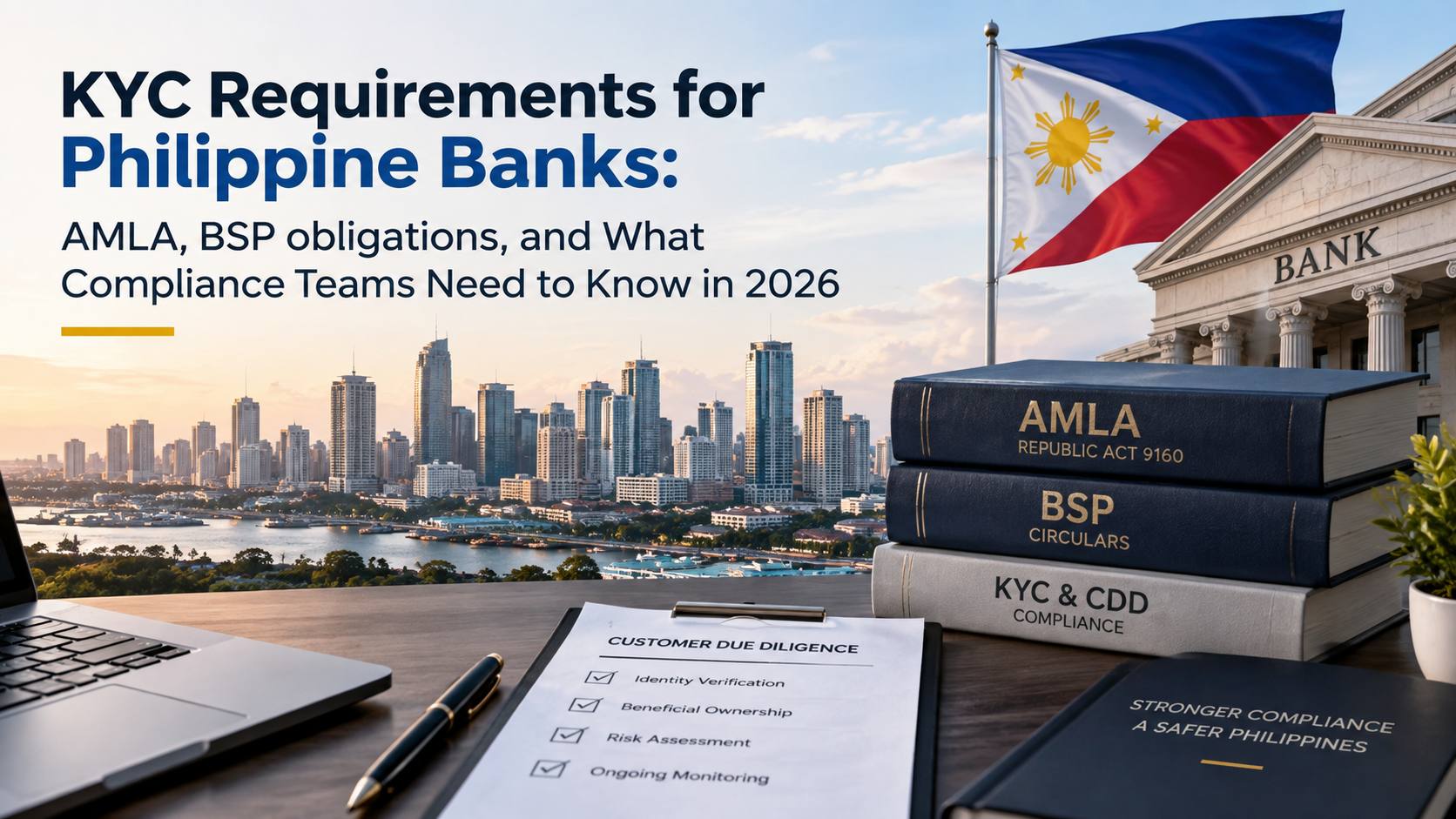
KYC Requirements for Philippine Banks: AMLA, BSP obligations, and What Compliance Teams Need to Know in 2026
The Philippines was removed from the FATF list of jurisdictions under increased monitoring in February 2025. This guide explains current AMLA and BSP KYC/CDD requirements for banks, including beneficial ownership, digital onboarding, reporting and record retention.
KYC Requirements for Philippine Banks: AMLA, BSP obligations, and What Compliance Teams Need to Know in 2026
The Philippines was removed from the FATF list of jurisdictions under increased monitoring in February 2025. This guide explains current AMLA and BSP KYC/CDD requirements for banks, including beneficial ownership, digital onboarding, reporting and record retention.